How our agents build personas from evidence, and why we threw out the first version
Two of our services use buyer personas, for two different jobs. Both now start from real evidence about people, not from the product. Here is how our agents build them, and what our first, product-written version got wrong.
A persona is a short description of a kind of buyer. Most teams write personas from the product: who would want this, and what would they ask? We did that too. Then we tested it, and it did not hold up.
This post is about how our agents build personas now: from evidence, with every persona keeping its sources. Two of our services use personas, and they do different jobs in each, so we describe them one at a time.
Two services, two jobs
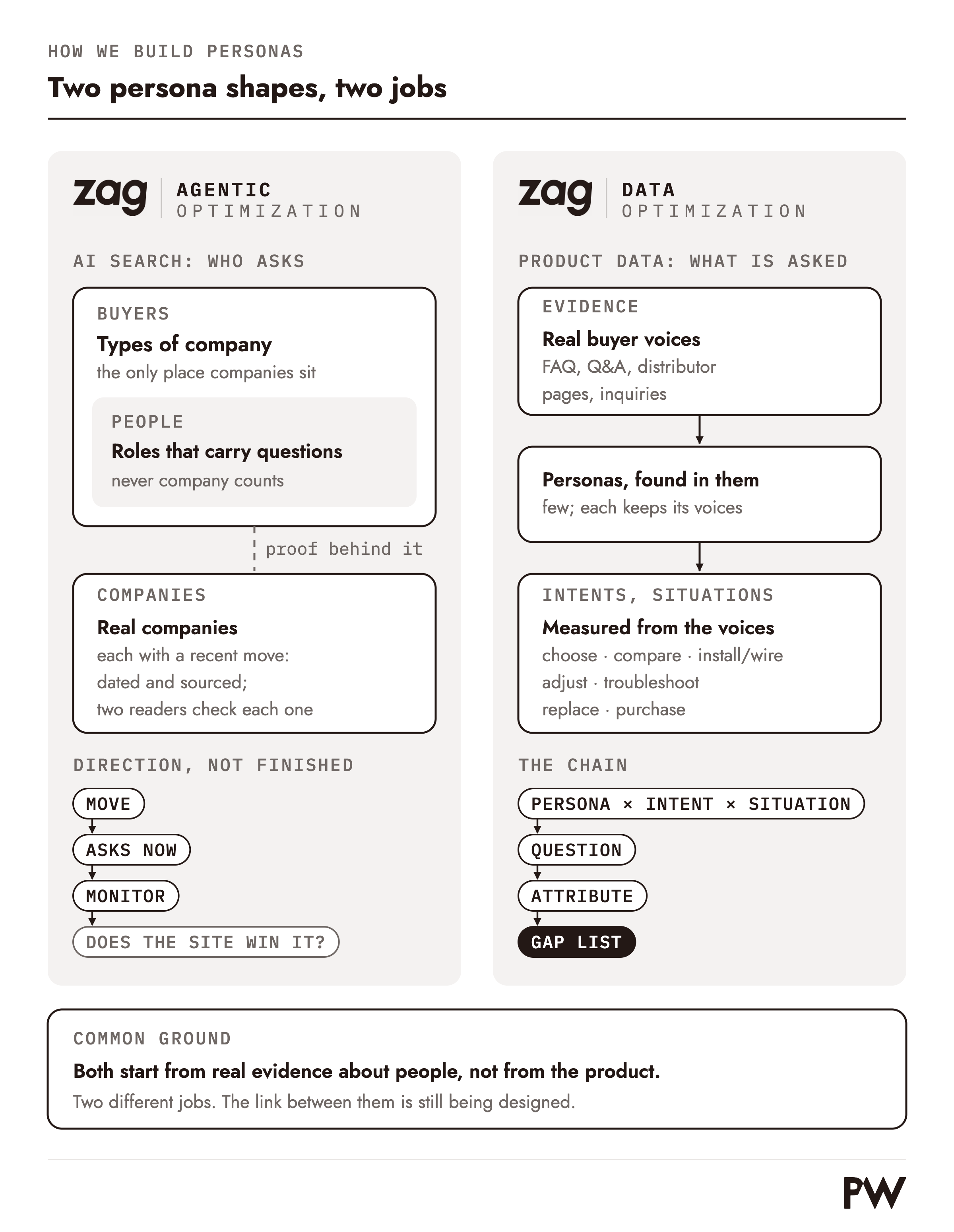
ZAG Agentic Optimization measures how AI assistants describe a brand's products, finds what they get wrong or leave out, and fixes the sources. ZAG Data Optimization turns catalogs, spec sheets, drawings and Excel files into a structured product master, with the source of every value.1
Both use personas. They use them for different things, and they are not joined up. How the two should connect is still being designed.
What they share is where they start: real evidence about people, not the product.
On the AI-search side: who asks, and why now
Here a persona is the kind of buyer who asks an AI a question before buying. It has two layers.2
- Buyers are types of company. This is the only layer where companies sit.
- People are the roles inside those companies that carry the questions. The people layer never counts companies.
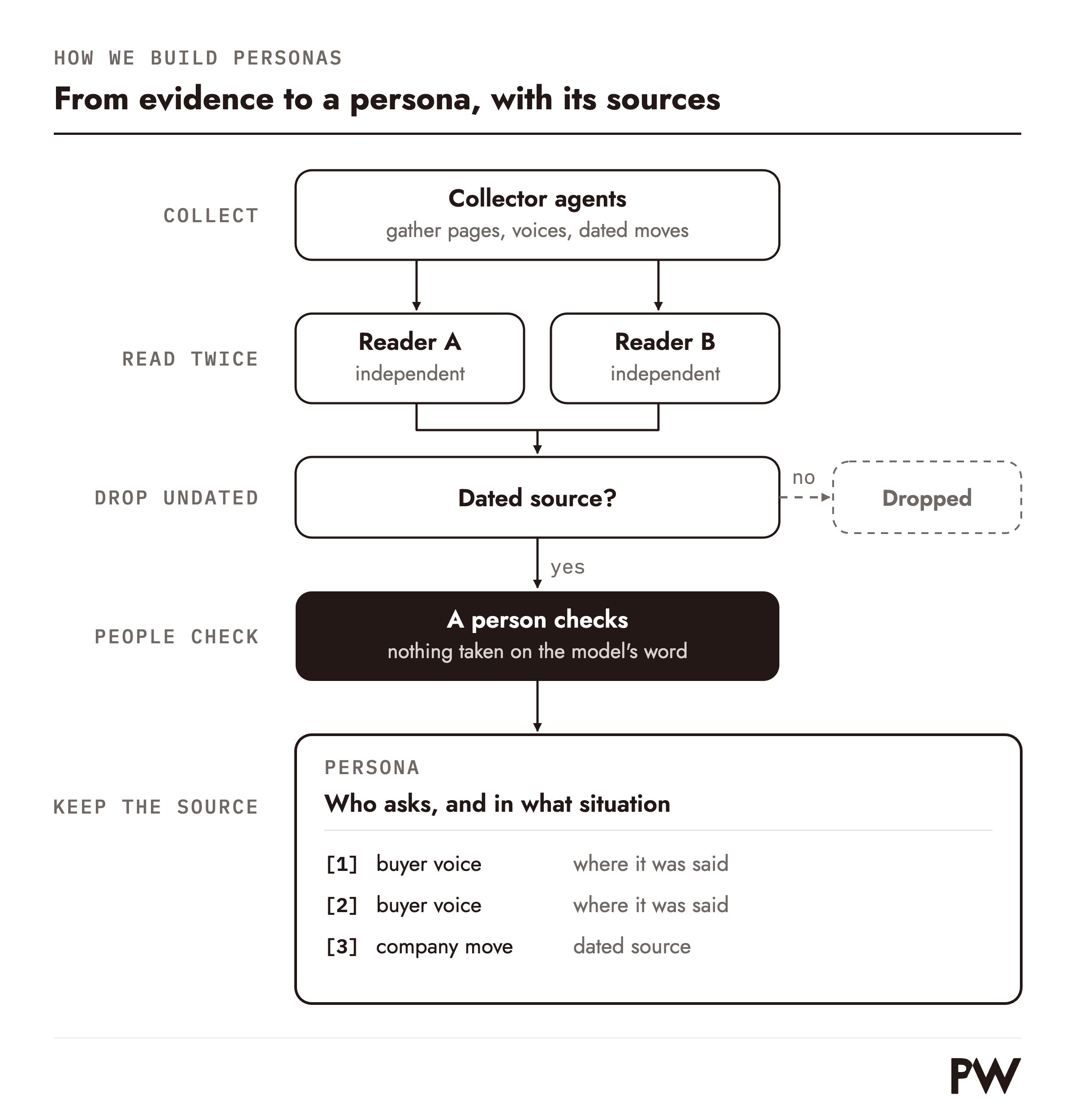
Companies are the proof behind a persona, not a sales list. Each one is a real company with a recent move that is dated and sourced: a new store or format, a change of system, a change in the rules it works under. Two independent readers check each company. Anything without a dated source is dropped.2
We keep two words apart. The persona is who asks. The signal is why now.
The chain we are building runs from the move, to the question it makes them ask now, to monitoring how AI answers that question, to checking whether the brand's own site and data win it. That full chain is the direction we are working in. It is not finished.
On the product-data side: what buyers actually ask
Here we start from buyer voices: FAQ pages, Q&A threads, distributor pages and inquiries. Before anything else, we split them into two piles: a build pile, and a held-out pile that is not used while building.2
From the build pile, agents find the personas in the voices. There are few of them, and each keeps the voices it came from. We also measure intents from the voices instead of assuming them: choose, compare, install or wire, adjust, troubleshoot, replace, purchase. And we record the situations buyers are in when they ask.2
The chain is persona × intent × situation → a question → the attribute that answers it. A by-product falls out of it: a gap list, the things buyers ask about that the product data has no attribute for.
Why we threw out the first version
Our first personas were written from the product and its catalog. Simulated buyers built from them asked questions in their voice.3
We scored those personas against held-out real questions. They did not beat a plain model asked with no personas at all.3
The reason was plain once we looked. The simulated buyers asked "which one should I choose?" Real buyers mostly asked how to wire it, how to adjust it, and what to replace it with.3 A persona written from the catalog asks the questions the catalog already answers.
So personas now come from real voices. And the held-out pile gives us a number that can go down: if a change to the method makes things worse, the score says so, and we cannot argue with it.
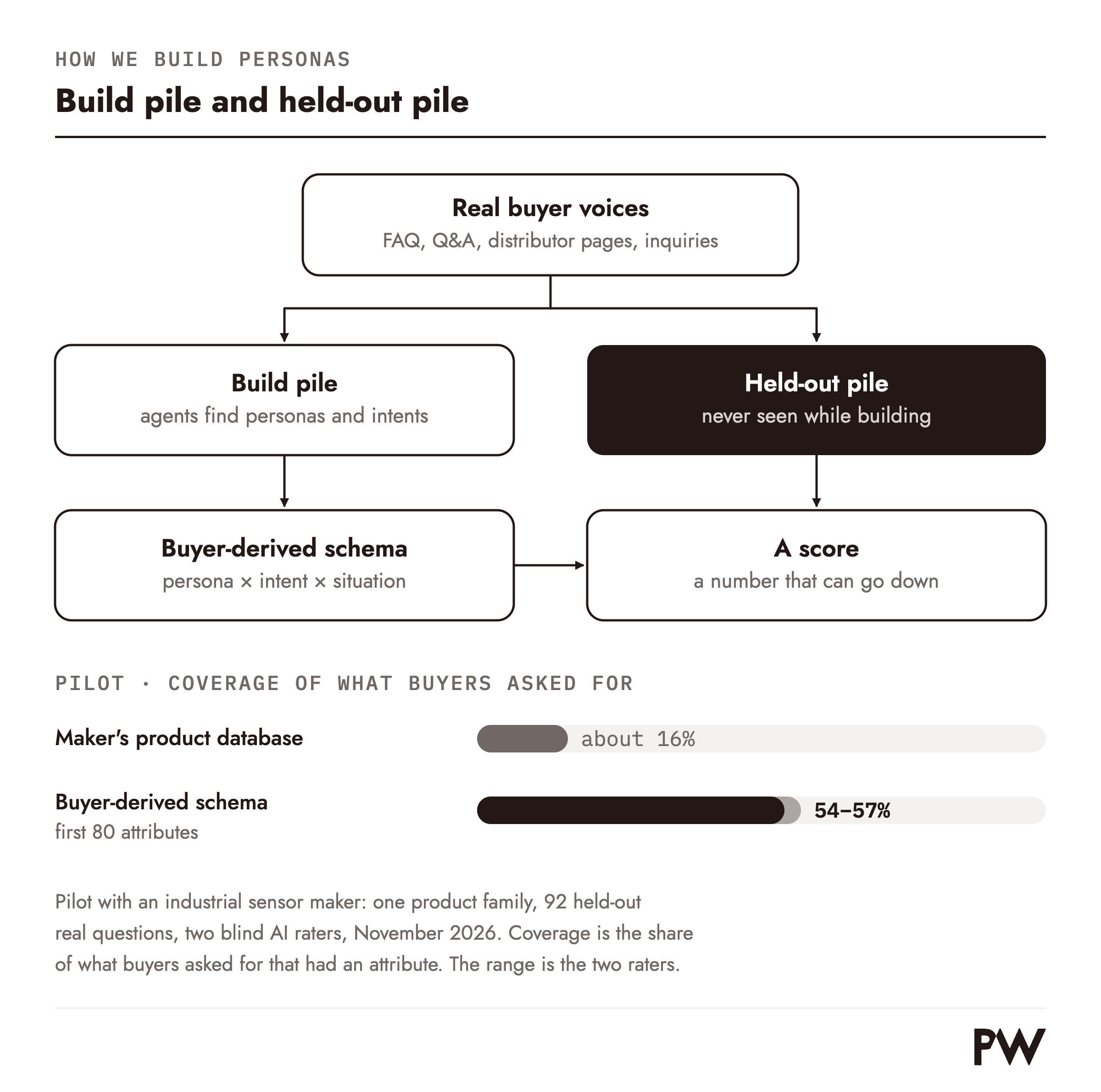
One pilot shows what that number looks like. With an industrial sensor maker, on one product family, we took 92 held-out real questions and had two blind AI raters match them in November 2026. We measured coverage: the share of what buyers asked for that had an attribute to answer it. The maker's own product database covered about 16%. The buyer-derived schema, at its first 80 attributes, covered 54 to 57%; the range is the two raters.4
That is one pilot on one product family. We read it as a direction, and we keep measuring.
How agents do the work
The pattern is the same on both sides, and it is the same one we use for engineering.2
- Collector agents gather the evidence: pages, buyer voices, dated company moves, each saved with where it came from.
- Two independent readers or raters check it. One agent's reading is not enough.
- People check at checkpoints. Nothing is taken on a model's word.
- Every persona and every company keeps its source. You can open a persona and see the voices or the dated pages behind it.
We call ourselves the provenance company: every value carries its source, and we answer for what our AI produces.1 A persona is a value too, and it is held to the same rule.
What we would tell another team
- Build personas from what buyers said, not from what you sell.
- Hold some real questions back before you start, and score against them.
- Compare against a plain model with no personas. If you cannot beat it, the personas are not helping.
- Keep the source on every persona, so anyone can check where it came from.
Sources
-
Pioneerwork Inc., company site. https://pioneerwork.co/ ↩ ↩2
-
Pioneerwork persona and research method (internal working rules, as of 2026-11). ↩ ↩2 ↩3 ↩4 ↩5
-
Pioneerwork internal evaluation, 2026: personas written from a product and its catalog, scored against held-out real buyer questions and compared with a plain model asked with no personas. ↩ ↩2 ↩3
-
Pioneerwork internal measurement, November 2026: pilot with an industrial sensor maker, one product family, 92 held-out real buyer questions, matched by two blind AI raters. Coverage is the share of what buyers asked for that had an attribute to answer it, at the buyer-derived schema's first 80 attributes. ↩