What Pioneerwork is, and how we build with agents
We are a small Tokyo team that runs AI for its customers and answers for every value it produces. This is how agents do most of our engineering work, and the rules that keep them honest.
Pioneerwork is a Tokyo company, founded in November 2019.1 Our product is ZAG. It reads catalogs, spec sheets, drawings and Excel files into structured product data, and every value it writes carries the place it came from.2
We run it as a managed service, not as a tool you operate yourself. Our team runs the AI, delivers the result and fixes any value that is wrong.3
This blog is where we write down how we do that work: the agents, pipelines and tooling behind it, and what broke on the way. This post covers the basics.
Why provenance comes first
An AI that writes product data will sometimes be wrong. A buyer, a retailer or another AI agent cannot tell a right value from a wrong one by looking at it.
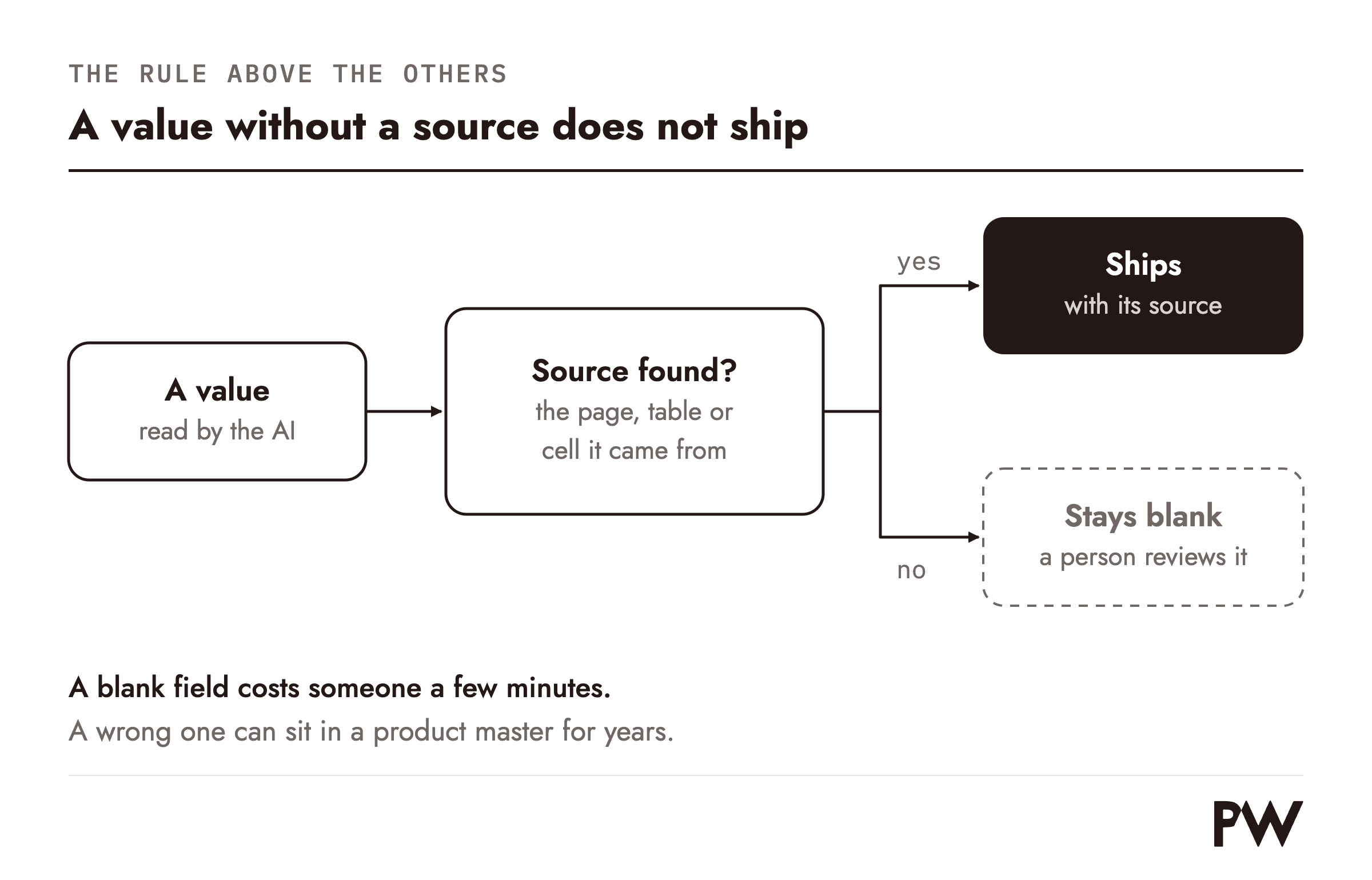
So we hold one rule above the others: a value without a source does not ship.4 If we cannot point at the page, table or cell a value came from, the field stays blank and goes to a person for review.
A blank field costs someone a few minutes. A wrong field can sit in a product master for years. We would rather deliver fewer values than one we cannot defend.4
How agents do the engineering
Most of our code, tests and reviews are written by coding agents. We use Claude Code, which can hand work to subagents that each run with their own instructions and context.5
The way we organise that work is plain:
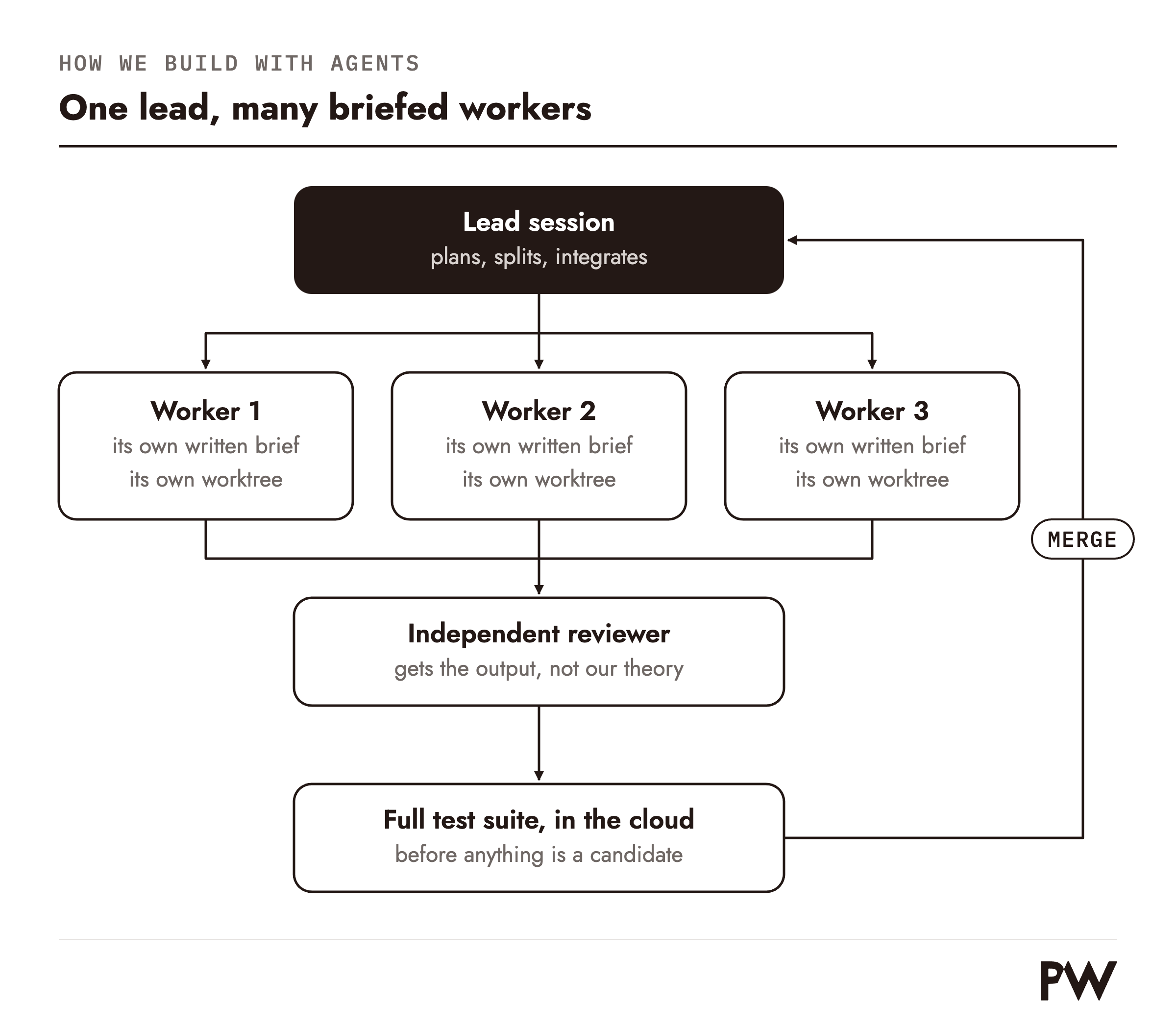
- A lead session plans and integrates. One agent session holds the plan, splits it into tasks and merges the results. It does not write every change itself.4
- Every worker gets a written brief. The goal, the files to read, what is already ruled out and how to prove the task is done. A worker knows only what its brief says, so the brief is where the quality starts.4
- Each worker has its own checkout. Parallel agents work in separate git worktrees, so two of them never edit the same files at the same time.6
- Reviews are independent. A reviewer agent gets the code or the output, not our conclusion about it. A reviewer handed a theory tends to confirm it.4
The rules that keep agents honest
Agents are fast and confident. That is useful, and it is also the risk. These rules come from things that went wrong:
- Run the full test suite before calling anything a release candidate. Targeted tests miss failures that cross between features.4
- Heavy runs happen in the cloud, not on a laptop. Test suites, replays of real documents and full runs go to cloud jobs, so a laptop going to sleep never decides a result.4
- Measure on real pages. A fix earns its place only when it corrects a wrong value on a real document, not a case we made up.4
- Write every decision down the day it is made. Customer requests, promises and engineering rulings go into a register in the repository, next to the code they affect.4
- Fix the delivered data first, then the code. When a delivered value is wrong, we correct it in place and note why. The code fix follows, tested, and ships when nobody is mid-task.4
None of this is unique to agents. Good teams have done it for years. Agents just make the cost of skipping it show up faster.
Go-to-market, the same way
We use the same pattern outside engineering. Research for go-to-market work, such as which companies and roles to reach and why, runs as briefed agents too. Every finding has to cite where it came from, the same as a product value.4
We wrote about that pipeline in its own post.
What comes next
Next, we will cover how we review agent output, how we stop wrong values from shipping, and how we run tests and staging with agents. Each claim will carry its source, the same as everything else we publish.
Sources
-
Pioneerwork Inc., notice under the Act on Specified Commercial Transactions (company details). https://withzag.com/legal/ ↩
-
ZAG, product site. https://withzag.com/ ↩
-
Pioneerwork Inc., company site. https://pioneerwork.co/ ↩
-
Pioneerwork engineering guidelines (internal working rules, as of 2026-11). ↩ ↩2 ↩3 ↩4 ↩5 ↩6 ↩7 ↩8 ↩9 ↩10 ↩11
-
Anthropic, Claude Code documentation, "Subagents". https://code.claude.com/docs/en/sub-agents ↩
-
Git documentation, "git-worktree: Manage multiple working trees". https://git-scm.com/docs/git-worktree ↩